


Affiliate Program Economics: How to Calculate CAC, LTV and Payback Period
Content:
- What Affiliate Program Economics Means
- What Costs Should Be Included in Affiliate CAC
- How to Calculate CAC for an Affiliate Program
- How to Calculate LTV from Affiliate Customers
- How to Measure Payback Period
- How CAC, LTV, and Payback Work Together
- Common Mistakes and How to Improve Affiliate Economics
- Conclusion
- FAQ
Introduction
An affiliate channel looks efficient only when its economics remain positive after all acquisition and servicing costs are counted. Many teams evaluate affiliate performance by gross revenue, order volume, or the headline commission rate. That approach hides the real picture. A channel can produce strong top-line growth and still destroy margin if it attracts low-quality customers, inflates discounts, or delays cost recovery. This is why affiliate program economics should be analyzed through unit economics, not traffic volume alone.
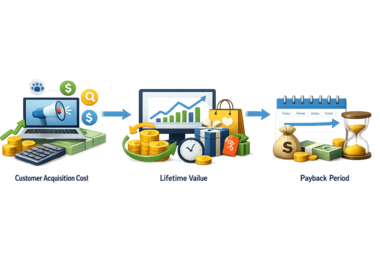
The three core metrics in that analysis are affiliate marketing CAC, LTV CAC ratio, and payback period in marketing. Customer Acquisition Cost shows how much the business actually pays to acquire a new customer through affiliates. Lifetime Value measures the economic contribution that customer generates over time. Payback Period shows how quickly the company recovers the initial acquisition spend. When these metrics are calculated correctly, they become a decision system for commission policy, partner segmentation, budgeting, and scaling.
This article explains how to calculate CAC, how to calculate LTV, and how to calculate payback period for an affiliate program with precision. It also covers cost allocation, data pitfalls, attribution issues, and practical ways to improve channel profitability without harming growth potential.
What Affiliate Program Economics Means
Affiliate program economics is the financial logic of acquiring customers through affiliate partners and monetizing those customers over time. In practice, it answers a narrow but decisive question: does the affiliate channel create profitable growth after all direct and indirect costs are included? The answer depends on more than conversion rates. It depends on customer quality, retention, discount dependency, refund rates, contribution margin, and operating expenses tied to the channel.
Affiliate should therefore be treated as a customer acquisition channel with its own unit economics profile. The same payout rate can produce different outcomes across partner types. A content partner may deliver fewer but more loyal customers. A coupon affiliate may deliver larger order volume but lower margin and weaker retention. An influencer may generate high-intent first purchases with strong repeat behavior. Economics must be measured at this granular level or the channel will be optimized around volume instead of value.
A practical framework for affiliate marketing unit economics includes four layers:
- Acquisition cost
- Gross profit generated by acquired customers
- Time needed to recover the acquisition spend
- Net incremental value after operational overhead and payment timing
This framework matters because affiliate revenue is often overstated in reports that ignore incrementality. If a user was already planning to purchase and only used an affiliate coupon at checkout, the affiliate partner may receive credit without creating real demand. In that case, reported channel revenue rises while incremental profit shrinks. Sound economic analysis filters out these distortions and focuses on marginal contribution.
What Costs Should Be Included in Affiliate CAC
To calculate customer acquisition cost affiliate marketing correctly, a business must include every expense required to generate and close affiliate-driven customer acquisition. The most visible cost is the partner commission, but that is only one component. Networks charge platform or override fees. Teams invest time in recruitment, compliance, creative production, feed management, tracking, analytics, and finance operations. Promotional placements, new partner bonuses, cashback subsidies, and fraud losses can materially change the true acquisition cost.
A narrow CAC formula based only on partner payout will almost always understate channel cost. This is especially dangerous in mature programs with multiple tools, dedicated account managers, and mixed compensation models. Once overhead is ignored, management concludes that the channel is cheaper than it actually is and expands spend into partner segments that do not meet margin targets. A correct CAC model should therefore distinguish between variable acquisition spend and channel-support costs, then assign those costs consistently.
Include the following categories in affiliate CAC formula calculations:
- Partner commissions on validated new-customer orders
- Network or SaaS platform fees
- Tenancy fees, placement fees, and fixed media buys
- Coupon subsidies and cashback reimbursements
- New partner activation bonuses
- Internal payroll share for affiliate managers, analysts, and designers
- Tracking, fraud prevention, and attribution software
- Creative production and landing page adaptation
- Refunds, cancellations, chargebacks, and fraud losses where relevant
Not every company allocates overhead in the same way, but the method must be stable. A finance team may assign internal costs by share of channel revenue, number of active partners, or time spent by the affiliate team. The exact method matters less than consistency across reporting periods. Consistent allocation allows trend analysis and partner comparison. Inconsistent allocation produces artificial efficiency shifts that do not reflect real business performance.
The table below shows a practical cost structure for affiliate CAC analysis.
| Cost category | Typical type | Should be included in CAC? | Why it matters |
| Partner commission | Variable | Yes | Direct acquisition cost tied to conversions |
| Network fee | Variable / fixed | Yes | Increases real cost per acquired customer |
| Placement fee | Fixed | Yes | Often used to secure premium visibility |
| Team payroll share | Fixed | Yes | Required to operate and optimize the channel |
| Fraud loss | Variable | Yes | Reduces real economic value of acquired orders |
| Refunds and cancellations | Variable | Yes | Reported conversions may not become realized revenue |
| General corporate overhead | Fixed | Usually no | Better tracked below contribution margin unless directly linked to channel |
The most common source of error is mixing acquisition cost with total marketing cost without separating new customers from returning buyers. Affiliate CAC should be built around new customer acquisition unless the business intentionally tracks reactivation or repeat purchase campaigns as separate economic models.
How to Calculate CAC for an Affiliate Program
The standard formula for how to calculate CAC for an affiliate program is straightforward:
CAC = Total Affiliate Acquisition Costs / Number of New Customers Acquired
The complexity lies in the definitions. “Total Affiliate Acquisition Costs” should include all direct and allocated indirect costs discussed above. “New Customers Acquired” should refer to validated first-time buyers, not all orders and not all attributed conversions. If the numerator includes costs related to all affiliate activity but the denominator includes both new and existing customers, CAC will look artificially low. Precision at the customer-status level is therefore mandatory.
A useful calculation process follows a fixed sequence. First, define the reporting window. Second, isolate first-time customers acquired through affiliate partners. Third, subtract invalid, canceled, refunded, or fraudulent orders. Fourth, sum all channel costs for the same period. Fifth, divide total cost by the number of validated new customers. This approach turns a generic affiliate CAC formula into a finance-grade metric suitable for budgeting and board reporting.
A robust workflow looks like this:
- Export all affiliate-attributed transactions for the period.
- Flag each customer as new, returning, or reactivated.
- Remove invalid orders and unresolved fraud.
- Sum partner commissions, platform fees, and fixed placements.
- Allocate team and tooling costs to the channel.
- Divide the final cost pool by validated new customers only.
Example: assume a company spent $48,000 on partner commissions, $6,000 on network fees, $10,000 on fixed placements, and $8,000 on internal channel support during one quarter. The program produced 1,600 affiliate-attributed orders, but only 900 of those were first-time customers after cancellations and fraud filters were applied. In that case, CAC equals $72,000 / 900 = $80. This figure is far more useful than cost per order because it reflects true new-customer acquisition efficiency.
Blended CAC should not be the final layer of analysis. Channel averages hide major differences across partner classes, markets, and campaigns. A coupon-heavy program may show acceptable blended CAC only because strong content affiliates are offsetting weak low-intent traffic. Segment CAC by partner type, geography, commission model, device, and landing page where volume allows. Channel management becomes materially better when CAC is analyzed at operational depth instead of top-level average.
How to Calculate LTV from Affiliate Customers
The next step is how to calculate LTV for customers acquired through affiliates. Lifetime Value estimates the gross profit contribution a customer generates over the period in which the business retains and monetizes that customer. For affiliate analysis, LTV should be measured on a channel-specific basis. Customers acquired from affiliates do not necessarily behave like paid search, organic, or direct customers. Their retention curve, repeat purchase frequency, basket composition, and discount sensitivity may differ sharply.
The cleanest version of affiliate LTV formula uses contribution economics rather than topline revenue. Revenue alone can exaggerate value because it ignores cost of goods sold, shipping subsidies, payment processing, and service cost. The more reliable version is based on gross margin or contribution margin. A customer with high revenue but weak margin can look attractive in a revenue-only model and fail in a profit-based model. For affiliate decisions, profit-based LTV is the metric that matters.
A practical formula is:
LTV = Average Order Value × Purchase Frequency × Customer Lifetime × Gross Margin
Another useful version is:
LTV = Average Revenue per Customer × Gross Margin × Average Customer Lifetime
The formula choice depends on data structure. Subscription businesses often model LTV through retention curves and monthly gross profit. Ecommerce businesses often use order value, repurchase rate, and margin. In both cases, the principle remains the same: affiliate-acquired customers should be measured as their own cohort. This is the only way to evaluate lifetime value affiliate marketing with channel relevance.
When estimating affiliate LTV, focus on these inputs:
- Average order value after discounts
- Repeat purchase frequency
- Retention by monthly or quarterly cohort
- Gross margin by product mix
- Refund and return rates
- Customer service intensity
- Time horizon used in the model
Suppose an affiliate-acquired customer places an average first order of $95 and an average repeat order of $88. Over a 24-month horizon, the average customer completes 3.2 total purchases and generates a blended gross margin of 52%. Estimated LTV would then be based on total revenue over those purchases multiplied by gross margin, adjusted for refund behavior where necessary. That result should then be compared against acquisition cost, not against commission rate alone.
LTV modeling must also account for customer quality differences inside the affiliate program. Editorial partners, niche communities, and expert reviewers often attract users with stronger retention and lower discount dependency. Incentivized or coupon traffic may create weaker post-purchase behavior, especially when the first order was driven by a price trigger rather than true product preference. The right answer is not to reject one category automatically, but to measure their cohort economics separately and adjust commission policy to match their long-term value.
How to Measure Payback Period
How to calculate payback period is one of the most practical questions in affiliate analysis because it connects growth to cash flow discipline. Payback Period measures the time required for the gross profit generated by an acquired customer to recover the acquisition cost. A channel may have a healthy long-term LTV and still strain the business if cost recovery takes too long. This is especially important for companies with tight working capital, aggressive inventory cycles, or investor pressure on cash efficiency.
The standard formula is:
Payback Period = CAC / Average Monthly Gross Profit per Customer
This formula works best when customer monetization is recurring or when repeat purchase behavior can be translated into an average monthly contribution stream. For businesses with irregular purchasing patterns, the metric is often modeled by cohort month: the team tracks cumulative gross profit generated by a cohort until it exceeds CAC. The point at which the cumulative curve crosses acquisition cost is the payback month.
Payback analysis is valuable for three reasons:
- It reveals whether the channel is financially scalable.
- It identifies partner segments that recover spend too slowly.
- It improves budgeting by linking acquisition to cash conversion timing.
Example: if affiliate CAC is $80 and the average affiliate-acquired customer produces $16 in monthly gross profit, the payback period is 5 months. If another partner type produces customers with the same LTV but only $8 in monthly gross profit early in the lifecycle, payback doubles to 10 months. Both segments may look acceptable in a long-horizon model, but only one may fit the company’s cash constraints.
Businesses often use internal thresholds for acceptable payback. These thresholds differ by model:
- Subscription SaaS may tolerate longer recovery if churn is low and margin is high.
- Ecommerce brands usually need shorter recovery because margin is realized through repeat orders and inventory ties up capital.
- Marketplaces often evaluate payback at both buyer and seller level if two-sided acquisition is involved.
A short payback period does not automatically mean the channel is superior. It may indicate high first-order monetization with weak long-term retention. A balanced assessment therefore combines payback with LTV and cohort stability. The best affiliate program is not the one that recovers cost fastest in isolation, but the one that generates durable profit at an acceptable recovery speed.
How CAC, LTV, and Payback Work Together
The three metrics should never be interpreted independently. Affiliate marketing CAC measures acquisition efficiency at entry. Lifetime value affiliate marketing measures economic value after acquisition. Payback period in marketing measures the speed of cost recovery. Together, they form the operating model of a scalable affiliate channel. A business that reads only one of them will make predictable mistakes. Low CAC without strong LTV may encourage scaling into low-value traffic. High LTV without acceptable payback may create cash pressure. Fast payback without durable retention may overstate strategic value.
The most common summary ratio is the LTV CAC ratio. It shows how much value the company receives for every unit of acquisition spend. Many businesses treat 3:1 as a healthy benchmark, but that number is not universal. A stable subscription business with strong retention may work well at a different ratio than a low-margin ecommerce business with heavy seasonal volatility. The ratio must be interpreted alongside gross margin, cash conversion timing, and risk. Finance teams should resist generic benchmarks and align target ranges with the company’s business model.
A practical way to read the three metrics together is:
- CAC answers: how expensive is acquisition?
- LTV answers: how valuable is the customer?
- Payback answers: how fast do we recover spend?
Consider two affiliate segments. Segment A has CAC of $60, LTV of $150, and payback of 4 months. Segment B has CAC of $45, LTV of $85, and payback of 7 months because post-purchase monetization is weak and delayed. Segment B looks cheaper at the point of acquisition but performs worse on long-term value and recovery speed. Without integrated analysis, the business may over-invest in the wrong traffic source.
These relationships should drive operating decisions. If CAC rises but LTV rises faster, the channel may still justify expansion. If CAC remains flat but payback worsens, the issue may be lower-margin product mix, weaker second-order behavior, or slower repeat cadence. If LTV looks strong while payback remains poor, the business may need tighter commission terms, narrower partner selection, or higher first-order margin. Economics become actionable only when the metrics are reviewed as one system.
Common Mistakes and How to Improve Affiliate Economics
The most common mistake in affiliate program profitability analysis is incomplete cost recognition. Many teams report commissions as the only cost line and ignore network fees, fixed placements, tooling, fraud, and payroll allocation. This error produces artificially low CAC and can lead to overpayment for traffic that does not hold margin after returns and discounting. Another frequent mistake is evaluating all affiliate conversions as equally valuable. In reality, customer quality varies significantly by partner type, traffic intent, and placement context.
A second major error is overreliance on simplistic attribution. Last-click logic often rewards the partner closest to checkout, not the partner that created demand. Coupon and cashback sites can therefore absorb large portions of the budget while content or discovery partners appear weaker than they are. That distorts partner strategy and depresses incremental return. The solution is not necessarily to abandon last-click reporting, because many programs still settle commissions that way, but to build a second analytical layer that evaluates incrementality, customer quality, and post-purchase value.
The following mistakes appear most often in affiliate partner profitability analysis:
- Counting all attributed orders instead of new customers
- Using revenue-based LTV without margin adjustment
- Ignoring refunds, cancellations, and fraud
- Blending all partner types into one average CAC
- Applying the same commission rate to partners with different customer quality
- Measuring performance by order count instead of contribution profit
- Expanding coupon exposure without testing incrementality
To improve affiliate channel profitability, companies should use a structured optimization process:
- Segment partners by role: discovery, content, loyalty, coupon, influencer, tech, and media.
- Calculate CAC, LTV, and payback for each segment separately.
- Reduce or redesign commissions for low-incrementality traffic.
- Introduce differentiated payouts tied to new-customer value.
- Remove partners with persistent negative contribution after full cost allocation.
- Prioritize affiliates that generate stronger repeat purchase cohorts.
- Build a dashboard that connects attribution data with retention and margin.
Commission architecture is one of the strongest levers available. A flat-rate payout treats unequal traffic as equal inventory. A better approach links reward to business value. Higher payouts can be assigned to partners that deliver first-time customers, higher-margin products, stronger retention, or faster payback. Lower payouts can be applied to late-funnel traffic with weak incrementality. This shifts the program from transaction buying to value buying.
Operational rigor also matters. An affiliate program improves when finance, growth, analytics, and partnership teams use the same metric definitions. If one team reports gross sales, another reports validated orders, and a third models margin after returns, no one is managing the same business. Shared definitions for CAC, LTV horizon, payback logic, and customer status are essential for credible decision-making.
Conclusion
Affiliate should not be managed as a simple payout mechanism. It is a performance channel with distinct unit economics that can strengthen or weaken company profitability depending on how acquisition cost, customer value, and recovery timing interact. Businesses that focus on order volume alone usually misread the channel. The correct lens is economic contribution from validated new customers after the full cost of acquisition has been recognized.
To build a sustainable program, companies need a reliable framework for how to calculate CAC, how to calculate LTV, and how to calculate payback period. CAC should include both direct and allocated channel costs. LTV should be cohort-based and margin-adjusted. Payback should measure the real speed of cost recovery. These metrics should then be compared across partner segments, not only at blended program level.
The practical outcome of this approach is better capital allocation. Teams can identify which partners generate real incremental value, which traffic sources erode margin, and which commission structures support profitable scale. In that sense, affiliate program economics is not a reporting exercise. It is a management discipline that determines whether affiliate growth is merely visible or genuinely valuable.
FAQ
- What is a good CAC for an affiliate program?
A good CAC depends on margin, payback window, and LTV — there’s no universal benchmark. Subscription businesses may tolerate higher CAC than one-time purchase ecommerce. The key is whether CAC supports a healthy LTV:CAC ratio and acceptable payback. Low CAC alone can be misleading if retention is weak or discount-driven. - Should affiliate commissions be included in CAC?
Yes. Commissions are a core acquisition cost and must be included. You should also factor in network fees, placements, internal costs, and refunds. Excluding these leads to overstated profitability. - Why can affiliate LTV differ from other channels?
Affiliate customers come with different intent (reviews, cashback, discounts), which impacts retention, AOV, and repeat behavior. LTV should be calculated by channel and ideally by partner type to reflect these differences. - What is a healthy LTV:CAC ratio?
3:1 is a common guideline, but it varies by margin, cash flow, and risk tolerance. A strong ratio can still be misleading if payback is slow or LTV assumptions are too optimistic. Always validate with cohort data. - Why is payback period important?
Payback shows how quickly CAC is recovered. Even profitable channels can strain cash flow if recovery is slow. It’s key for scaling decisions and commission strategy. - Should I measure program-level or partner-level metrics?
Both. Program-level metrics guide budgeting and reporting. Partner-level metrics enable optimization and reveal which partners drive or destroy value. Blended data can hide underperformance.



Best Affiliate Marketing Software for SaaS in 2026: Top Platforms Compared
Affiliate marketing remains one of the most efficient acquisition channels for subscription businesses because it ties partner compensation to measurable revenue.

Affiliate Partner Types: Media Buyers, Content Sites, Influencers, Communities
Affiliate marketing is not a single traffic model. It is a partner ecosystem made up of channels with different economics, attribution patterns, audience relationships, and operational requirements.

Affiliate Marketing Traffic Sources in 2026: SEO, TikTok, Communities & AI Discovery
Affiliate growth now depends on distribution resilience rather than on a single winning tactic. The old model, in which a publisher could build revenue around one source of visits, has become unstable.
