


Affiliate Program Migration Checklist: Platforms, Data, and Risks
Content:
- Core Migration Checklist (7 Key Steps)
- Platform Selection & Compatibility
- Data Audit & Mapping
- Tracking & Attribution Setup
- Financial & Commission Validation
- Affiliate Communication Plan
- Compliance, Privacy & Legal Risks
- Post-Migration Testing & Optimization
- Monitoring Performance After Launch
- Common Risks During Affiliate Program Migration
- What Can Go Wrong and How to Prevent It
- Best Practices & Expert Tips
- Conclusion
- FAQ
Introduction
Affiliate program migration is a complex operational process that affects tracking accuracy, partner trust, financial integrity, and revenue continuity. Companies usually initiate migration when existing technology no longer supports growth, compliance requirements change, or operational costs exceed platform value. Without a structured approach, migration can result in data loss, broken attribution, and affiliate churn.
A well-defined affiliate program migration checklist allows businesses to move between platforms while preserving historical performance data, maintaining uninterrupted tracking, and minimizing financial and legal risks. This article outlines a practical framework covering platforms, data handling, compliance, and post-migration optimization.
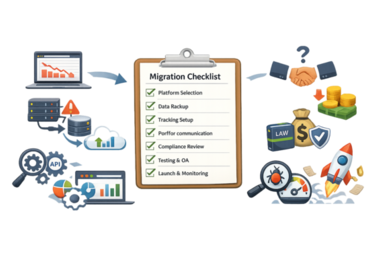
Core Migration Checklist (7 Key Steps)
A successful migration follows a sequential logic rather than a technical switch. Each step addresses a specific dependency that directly impacts performance stability and partner retention. Skipping or compressing steps increases the probability of revenue gaps and operational disputes.
The checklist below reflects best practices used by mature affiliate programs in eCommerce, SaaS, and regulated industries.
Platform Selection & Compatibility
Choosing a new platform is a strategic decision rather than a technical replacement. The platform defines tracking logic, attribution models, reporting depth, and scalability limits. A mismatch between business requirements and platform capabilities often forces repeated migrations.
Key compatibility factors include:
- Supported tracking methods (cookie-based, server-side, hybrid)
- API availability and documentation quality
- Integration with CRM, billing, and analytics tools
- Traffic volume limits and cost structure
When evaluating options for affiliate platform migration, businesses should test real conversion flows instead of relying solely on demos. Choosing an affiliate program migration platform that supports real-world attribution scenarios, flexible APIs, and scalable tracking infrastructure significantly reduces post-launch risks.
Data Audit & Mapping
Data migration starts with a detailed audit of all affiliate-related datasets. This includes partner profiles, historical conversions, commission tiers, sub-ID logic, and attribution windows. Any missing or inconsistent field must be identified before export.
Data mapping ensures structural compatibility between the old and new platforms. Common mapping challenges include different naming conventions, incompatible attribution hierarchies, and commission logic mismatches. Without proper mapping, affiliate data migration may lead to inaccurate reporting and partner disputes.
Typical datasets included in migration:
- Affiliate accounts and statuses
- Historical conversions and timestamps
- Commission models and overrides
- Custom parameters and sub-ID logic
Tracking & Attribution Setup
Tracking setup is the most technically sensitive phase of migration. Even minor configuration errors can break attribution chains and cause revenue leakage. Modern affiliate programs increasingly rely on server-side tracking to improve accuracy and privacy compliance.
Before launch, all attribution scenarios must be tested, including:
- First-click and last-click logic
- Cross-device conversions
- Duplicate conversion prevention
Testing environments should replicate production conditions. This step is critical for avoiding affiliate tracking migration failures that surface only after affiliates report missing conversions.
Financial & Commission Validation
Financial integrity determines affiliate trust during migration. All outstanding balances, pending commissions, and payment schedules must be reconciled before switching platforms. Any discrepancy can escalate into disputes or reputational damage.
A validation checklist should include:
- Verification of unpaid commissions
- Currency and tax configuration review
- Alignment of payout thresholds and schedules
Programs that migrate without financial reconciliation often face post-launch correction costs. Migrate affiliate program processes should treat payments as immutable records rather than adjustable estimates.
Affiliate Communication Plan
Affiliate communication must be proactive, structured, and transparent. Partners need advance notice, technical instructions, and clear timelines. Silence or late updates often lead to traffic loss during transition periods.
An effective communication plan includes:
- Migration timeline with milestones
- Instructions for updating tracking links
- Access to updated creatives and documentation
- Dedicated support contact
Clear communication reduces churn and preserves partner confidence during affiliate program migration.
Compliance, Privacy & Legal Risks
Regulatory compliance becomes more complex during migration due to data transfers and tracking changes. Programs operating under GDPR, ePrivacy, or sector-specific regulations must reassess consent mechanisms and data processing agreements.
Key compliance checkpoints:
- Lawful basis for data transfer
- Updated privacy policies
- Affiliate agreement amendments
- Consent handling for new tracking methods
Ignoring legal dependencies can expose companies to penalties and partner claims. Affiliate tracking risks often originate from outdated compliance assumptions.
Post-Migration Testing & Optimization
Migration does not end at launch. Post-migration testing validates real-world performance against historical benchmarks. Traffic quality, conversion rates, and attribution consistency must be monitored continuously.
Optimization focuses on closing performance gaps caused by:
- Attribution model changes
- Tracking latency
- Affiliate behavioral shifts
Programs that allocate resources for post-migration optimization recover faster and maintain revenue stability.
Monitoring Performance After Launch
Performance monitoring should compare pre- and post-migration metrics over identical time windows. Sudden deviations often indicate tracking errors or misconfigured attribution logic.
Core metrics to monitor:
- Conversion rate by affiliate
- Approval and rejection ratios
- Average commission per conversion
- Traffic-to-conversion lag
Continuous monitoring allows early detection of affiliate tracking risks and prevents long-term revenue erosion.
Common Risks During Affiliate Program Migration
Migration risks are predictable and often repeatable across industries. The most common issues arise from underestimating dependencies between tracking, data, and partner behavior.
Primary risk categories include:
- Incomplete data transfers
- Broken tracking links
- Affiliate disengagement
- Payment delays
Each risk can be mitigated through structured planning and staged execution.
What Can Go Wrong and How to Prevent It
Failures typically occur when migration is treated as a technical task rather than a business process. Preventive measures include parallel tracking, phased rollouts, and rollback plans.
Risk prevention strategies:
- Run old and new platforms in parallel during transition
- Validate conversions daily during launch week
- Maintain contingency budgets for reconciliation
Proactive controls reduce downtime and protect revenue streams.
Best Practices & Expert Tips
Experienced affiliate managers prioritize predictability over speed. Gradual migration, internal documentation, and test affiliates significantly reduce operational stress.
Expert recommendations:
- Avoid migrating during peak sales periods
- Involve finance and legal teams early
- Document all configuration changes
- Keep affiliates informed weekly
Best practices ensure the affiliate program checklist delivers measurable results.
Conclusion
Affiliate program migration is a multi-layered process requiring coordination across technology, finance, compliance, and partnerships. A structured checklist minimizes risk while preserving performance continuity.
Companies that invest in planning, testing, and communication transform migration into a strategic upgrade rather than a disruption. Long-term benefits include improved tracking accuracy, regulatory resilience, and scalable partner growth.
FAQ
- How long does affiliate program migration usually take?
Most migrations take between four and twelve weeks, depending on data volume, platform complexity, and regulatory requirement. - Can affiliates lose their tracking history during migration?
Yes, if historical data is not properly exported, mapped, and validated before launch.. - Should migration be gradual or immediate?
A phased migration with parallel tracking is safer and reduces revenue volatility. - How can tracking be tested before full launch?
By running test conversions across multiple attribution scenarios and validating reports in real time. - What is the biggest risk during affiliate migration?
Loss of tracking accuracy, which directly impacts affiliate trust and revenue attribution.



Best Affiliate Marketing Software for SaaS in 2026: Top Platforms Compared
Affiliate marketing remains one of the most efficient acquisition channels for subscription businesses because it ties partner compensation to measurable revenue.

Affiliate Program Economics: How to Calculate CAC, LTV and Payback Period
An affiliate channel looks efficient only when its economics remain positive after all acquisition and servicing costs are counted.

Affiliate Partner Types: Media Buyers, Content Sites, Influencers, Communities
Affiliate marketing is not a single traffic model. It is a partner ecosystem made up of channels with different economics, attribution patterns, audience relationships, and operational requirements.
