
Lead Distribution API: Real-Time Routing, Webhooks and Integrations

Introduction
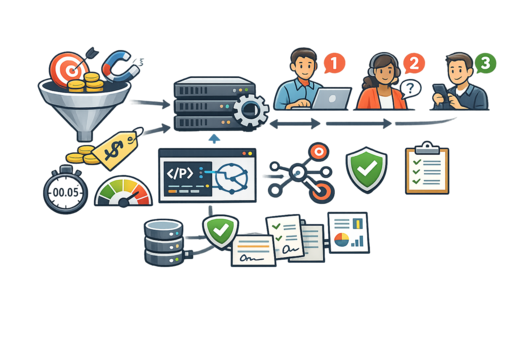
A lead’s price is set at the moment of distribution, not at capture. The routing decision — which buyers see it, in what order, and at what timeout — determines revenue per record, and it executes in milliseconds.
Speed is a measurable variable downstream: industry studies place contact within five minutes at roughly 21 times more effective than contact after thirty. This guide covers the lead distribution api as an engineering object — architecture, ping-post protocol, routing rules, webhook reliability, authentication, compliance fields, monitoring. For teams building routing infrastructure around high-intent inquiries, real-time lead distribution API software can help connect ingestion, validation, buyer rules, delivery logic, consent data, and reporting inside one controlled workflow.
Lead Distribution API Architecture: How the System Works End to End
The platform sits between traffic sources and buyer systems, and traffic moves in two directions. Sources post records inward through an ingestion endpoint; buyers receive them outward through delivery calls. Confusing the two produces integration errors that surface only under load.
Five components handle the path: ingestion, validation, routing engine, delivery, logging. Validation runs synchronously — duplicate checks, suppression lists, format normalization, and field rules execute before routing, since a rejected record should never consume auction capacity.
- Ingest — accepts the source payload, assigns an internal ID, returns an acknowledgment;
- Ping — broadcasts qualifying fields to matched buyers and collects bids;
- Post — delivers the full record to the winning buyer;
- Status — exposes record state for source-side polling;
- Returns — accepts buyer rejections inside the contractual window;
- Reporting — serves aggregated performance and reconciliation data.
Rate limits, timeouts, and concurrency ceilings differ per endpoint. Ingest tolerates queuing; ping does not, because every millisecond narrows the window before the consumer leaves the page.
The Ping-Post Protocol: Request and Response Cycle
Ping-post separates qualification from delivery. The ping carries only non-identifying fields: postal code, state, vertical, qualifying attributes. Buyers price the record from those alone, and the winning bidder receives the complete record in a second call.
The ping post api cycle runs in a fixed sequence:
- Extract — the platform pulls qualifying fields from the submitted record into a ping payload.
- Match — buyer filters are evaluated to identify eligible recipients before any request fires.
- Broadcast — the ping goes to matched buyers, in parallel or sequentially by tier.
- Collect — buyers return a bid, a rejection, or nothing. Timeout windows are commonly configured between 500 and 2,000 milliseconds.
- Resolve — valid bids are ranked and a winner selected against margin rules.
- Post — the full record, with contact fields and consent artifacts, goes to the winner only.
- Confirm — the buyer accepts or rejects; rejection triggers fallback to the next bid.
Losing bidders never receive identifying data. That constraint is the compliance architecture, not a courtesy: a record posted to several buyers before acceptance loses exclusivity and generates disputes. JSON is the working standard, though legacy endpoints in insurance and finance still require XML, making format translation a permanent requirement rather than a migration task.
Routing Logic: Ping Trees, Tiers and Buyer Rules
A ping tree has three components: routing rules establishing eligibility, tier definitions setting order, and performance signals adjusting placement. Rules answer whether a buyer sees the record, tiers answer when, signals answer whether that position holds next week.
Distribution modes serve different commercial models:
- Price-based — the highest valid bid wins, maximizing revenue per record;
- Priority — fixed buyer order independent of bid, for contractual volume commitments;
- Weight-based — proportional allocation across buyers at comparable rates;
- Parallel ping — simultaneous broadcast, lowest latency, highest request volume;
- Even distribution — equal shares, where relationship parity outranks yield.
Configure a new buyer in this order:
- Eligibility filters — geography, vertical, custom field conditions, suppression lists.
- Capacity controls — hourly, daily, and monthly caps plus schedule windows.
- Delivery method and endpoint, with field mapping to the buyer schema.
- Timeout and retry parameters specific to that endpoint’s measured response profile.
- Tier assignment, initially conservative, then adjusted against acceptance rate, response time, and conversion data.
Fallback chains recover revenue after post rejections. Without one, a rejected record becomes unsold inventory instead of returning to the auction.
Webhooks: Event Design, Delivery Guarantees and Failure Handling
Webhook lead delivery inverts control: the platform pushes each record when ready instead of the buyer polling for inventory. Polling adds latency averaging half the interval and generates request volume orders of magnitude higher than event-driven delivery.
A production payload carries a stable envelope — event ID, type, timestamp, schema version — wrapping a typed data object. Versioning the envelope separately from the data allows schema changes without breaking consumers.
Reliability requirements:
- Event taxonomy — record created, routed, accepted, rejected, returned, disputed;
- Signature verification — HMAC over the raw body with a timestamp tolerance window;
- Response contract — any 2xx acknowledges receipt, non-2xx triggers the retry path;
- Retry policy — exponential backoff with a defined attempt ceiling;
- Idempotency keys — a stable event ID lets the receiver discard duplicates safely;
- Dead-letter queue — permanently failed deliveries held for inspection and replay;
- Reconciliation sweep — a scheduled pull recovering anything the push path lost.
Receivers must acknowledge before processing. A handler returning 2xx only after writing to a CRM times out under load and triggers retries that duplicate stored records.
Authentication, Security and Compliance Fields
Authentication runs per buyer, not per platform: API keys scoped to a single buyer account, OAuth 2.0 for delegated access, mutual TLS where security policy requires it, IP allowlisting as a supplementary control. Keys need documented rotation and immediate revocation, since a leaked credential exposes consumer records rather than aggregate statistics.
Compliance obligations shape the payload itself:
- Consent artifacts — timestamp, originating IP, disclosure language, certificate URLs from verification providers;
- TCPA — prior express written consent captured and auditable per record in phone-contact verticals;
- Data minimization — the ping excludes identifying fields to satisfy state privacy requirements;
- Audit trail — which buyer received which record, when, at what price, under what disposition;
- Return windows — contractual rejection periods enforced on the returns endpoint.
Treat the audit trail as a primary system output. Disputes are settled by delivery logs, and logs written asynchronously without ordering guarantees fail under scrutiny.
Integration Patterns: CRM, Dialers, Call Routing and Analytics
Buyer destinations vary more than seller sources. Records land in CRM systems, dialers, or sales engagement platforms, each with its own schema, authentication model, and rate limits. Field mapping belongs in the platform layer, so the source form stays unchanged when a buyer alters requirements.
Common integration surfaces:
- CRM — Salesforce, HubSpot, and vertical systems, usually REST with per-object rate limits;
- Dialers and contact centers — outbound triggering, where delivery latency drives contact rate;
- Call routing — ring trees and tracking numbers for pay-per-call traffic beside data leads;
- Email and SMS — fallback for buyers without an API, at the cost of structured confirmation;
- Analytics and BI — warehouse sync, scheduled exports, or streaming events for margin analysis;
- Form and landing providers — the ingestion side, where naming discipline prevents mapping debt.
When multiple traffic sources, buyers, agencies, or internal teams participate in the same workflow, a partner operations platform for lead buyers and sources can help organize partner access, performance visibility, commission rules, reporting permissions, and operational accountability around the distribution process.
Detect integration failures at the semantic level, not the transport level. An endpoint returning 200 with an error body inside is more damaging than one returning 500: the platform records success while the buyer never processes the record.
Latency, Error Handling, Monitoring and Reconciliation
Latency is a budget allocated across stages, not a single number. Each stage carries its own timeout and failure mode, and the sum decides whether real time lead distribution completes before the consumer session ends.
Monitor per buyer, not in aggregate. Acceptance rate drift, response-time percentiles, and error rate by endpoint expose a degrading integration before revenue reflects it. Circuit breakers stop one slow buyer from consuming auction capacity across all traffic. Reconcile platform records against buyer-reported outcomes daily; deviation beyond two to three percent signals a mapping or timing error, not normal variance.
Conclusion
Routing decisions are revenue decisions executed in milliseconds, and the engineering constraints follow from that. Timeout selection, fallback configuration, and retry policy each translate directly into sold or unsold inventory.
Specify three things before writing integration code: the latency budget by stage, the event contract including envelope versioning, and the failure paths for every external call. Test rejection, timeout, and duplicate delivery deliberately — systems that handle the success path well and failure paths poorly break at exactly the volume where cost is highest.
FAQ
[1] What is a lead distribution API?
An interface that accepts records from traffic sources, routes them against buyer rules in real time, and delivers the full record to the winning buyer with an auditable trail.
[2] How does ping-post differ from direct post?
Direct post sends the complete record to one predetermined buyer. Ping-post first offers non-identifying fields to multiple buyers, collects bids, then posts only to the winner.
[3] How long should a ping timeout be?
Windows are commonly configured between 500 and 2,000 milliseconds. Shorter windows exclude slower buyers; longer ones risk losing the consumer session.
[4] How are webhooks secured against spoofing?
HMAC signatures computed over the raw request body, verified with a timestamp tolerance window that rejects replayed requests outside it.
[5] How are duplicate deliveries prevented?
Stable event IDs used as idempotency keys. The receiver stores processed IDs and discards repeats, which makes retries safe by design.
[6] Why does the ping exclude personal data?
Losing bidders would otherwise retain identifying records they never purchased. Excluding those fields satisfies data minimization requirements and preserves exclusivity.
Become a champion with irev
[Only 9 slots left this month]
Irev puts your partner program on the fast track to real growth


 SIGMA Award Winner
Best marketing solution provider
SIGMA Award Winner
Best marketing solution provider