


Why Last-Click Attribution Breaks When Affiliate Programs Scale
Content:
- Over-crediting Bottom-of-Funnel Partners
- Ignoring Upper- and Mid-Funnel Influence
- Distorted Partner Incentives
- Misleading ROI and Budget Allocation
- Poor Decision-Making in Global and Multi-Market Programs
- Better Alternatives to Last-Click Attribution
- Conclusion
- Frequently Asked Questions (FAQ)
Introduction
Last-click attribution has long been the default measurement model in affiliate marketing. It assigns 100% of the conversion value to the final touchpoint before purchase, offering a clear and technically simple way to track performance. For early-stage affiliate programs with limited partners and linear user journeys, this approach can provide a rough but usable signal.
However, once affiliate programs scale, the customer journey becomes fragmented across multiple devices, channels, and touchpoints. In this environment, last-click attribution stops reflecting economic reality, making advanced affiliate attribution essential for accurate partner valuation and sustainable growth decisions.. It systematically misrepresents partner value, distorts ROI calculations, and leads to structurally flawed growth decisions. This article explains why these failures occur and which attribution approaches perform better at scale.
Over-crediting Bottom-of-Funnel Partners
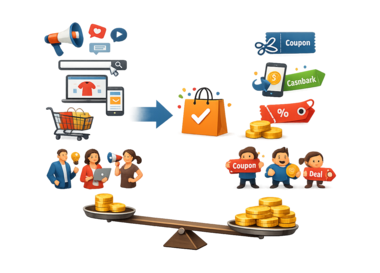
When affiliate programs grow, bottom-of-funnel partners such as coupon sites, cashback platforms, and deal aggregators increasingly dominate last-click reports. These partners frequently appear immediately before conversion, not because they created demand, but because users actively seek them out at the final purchase stage.
As a result, affiliate marketing attribution based on last-click over-credits partners who primarily capture existing intent. This creates a skewed performance picture in which high-visibility does not equal high incremental value. Programs end up rewarding traffic interception rather than customer acquisition.
Common consequences include:
- Inflated conversion rates for coupon and cashback affiliates
- Commission leakage on transactions that would have converted organically
- Reduced investment in partners that introduce new users
This structural bias intensifies as program scale increases and deal-based traffic grows faster than discovery-driven channels.
Ignoring Upper- and Mid-Funnel Influence
Upper- and mid-funnel affiliates—such as content publishers, bloggers, comparison platforms, and influencers—rarely receive last-click credit. Their role is informational and persuasive rather than transactional, which places them earlier in the decision cycle.
By relying on last-click attribution, programs effectively erase these partners from performance reports. This creates a false narrative that content and influence channels underperform, despite their measurable impact on brand awareness, consideration, and assisted conversions.
Key effects include:
- Loss of visibility into assisted conversion paths
- Underestimation of content-driven demand generation
- Systematic underpayment of high-effort partners
At scale, this leads to a shrinking content ecosystem and an over-reliance on transactional traffic sources.
Distorted Partner Incentives
Attribution models directly shape affiliate behavior. When last-click is the sole success metric, affiliates optimize for being the final touchpoint rather than for creating value earlier in the funnel.
This drives partners toward tactics such as:
- Brand keyword bidding
- Cookie overwriting and forced redirects
- Aggressive coupon injection at checkout
These behaviors are rational responses to the incentive structure but harmful to long-term program health. Affiliate program scaling under last-click conditions often results in a race to the bottom, where quality partners exit and low-effort arbitrage players dominate.
Over time, the partner mix deteriorates, increasing dependency on non-incremental traffic.
Misleading ROI and Budget Allocation
One of the most damaging effects of last-click attribution is its impact on ROI analysis. Because credit is assigned to the final interaction, ROI calculations systematically favor low-cost, low-incrementality partners while penalizing channels that require upfront investment.
This leads to incorrect budget decisions, including:
- Cutting content partners that drive assisted value
- Scaling commission payouts to partners with minimal incremental lift
- Overestimating channel efficiency at the program level
The table below illustrates the disconnect:
| Partner Type | Last-Click ROI | Incremental Impact |
| Coupon Sites | High | Low |
| Cashback Platforms | High | Low–Medium |
| Content Publishers | Low | High |
| Influencers | Low | High |
Such misalignment becomes more expensive as program volume increases, making performance marketing attribution accuracy a financial necessity rather than an analytical preference.
Channel Overlap and Attribution Conflicts
As affiliate programs mature, they increasingly overlap with other paid channels, including paid search, retargeting, email marketing, and paid social. Last-click attribution lacks the ability to resolve these interactions coherently.
Typical failure modes include:
- Assigning affiliate credit to conversions driven by paid media
- Double-counting value across internal and partner channels
- Arbitrary credit assignment based on click timing rather than influence
These conflicts grow with channel diversification. Without a multi-touch perspective, attribution becomes less a measurement system and more a reflection of technical tracking order.
Poor Decision-Making in Global and Multi-Market Programs
Scaling affiliate programs internationally introduces additional complexity. User behavior varies by region, including research duration, device switching, and channel trust. Last-click attribution ignores these differences entirely.
In global programs, this leads to:
- Misreading regional partner performance
- Penalizing markets with longer consideration cycles
- Overvaluing markets with aggressive deal usage
Cross-device journeys and delayed conversions further reduce accuracy. As a result, affiliate attribution models based solely on last-click become increasingly unreliable at the multi-market level.
Better Alternatives to Last-Click Attribution
While no single model is universally optimal, several approaches outperform last-click attribution in scaled environments. These models focus on contribution rather than position.
More effective options include:
- Assisted conversion reporting to measure supporting influence
- Position-based models that reward both introduction and closure
- Time-decay models that weight interactions by proximity
- Incrementality testing using holdouts and controlled experiments
In practice, leading programs combine multiple methods into hybrid frameworks. This approach provides a more realistic view of incremental value affiliates and supports sustainable growth decisions.
Conclusion
Last-click attribution fails at scale because it was never designed for complex, multi-touch customer journeys. As affiliate programs grow, its structural biases distort partner valuation, misallocate budgets, and incentivize low-quality behavior.
Modern affiliate programs require attribution systems that reflect how demand is created, influenced, and converted. Moving beyond last-click is not an analytical upgrade—it is a strategic requirement for scalable, profitable growth.
FAQ
- Is last-click attribution still useful?
Yes, but only as a directional or diagnostic metric. It should not be the primary basis for partner evaluation or budget decisions. - When does last-click attribution start to break down?
It typically fails once programs expand beyond coupon-driven traffic and introduce content, influencers, and paid media overlap. - What is the biggest financial risk of last-click attribution?
Overpaying for conversions that would have occurred without affiliate involvement. - Which attribution model is best for affiliate programs?
There is no universal solution. Hybrid models combined with incrementality testing deliver the most reliable results. - Can affiliate networks support non–last-click attribution?
Some networks offer partial solutions, but many programs rely on external analytics and custom attribution frameworks.



Best Affiliate Marketing Software for SaaS in 2026: Top Platforms Compared
Affiliate marketing remains one of the most efficient acquisition channels for subscription businesses because it ties partner compensation to measurable revenue.

Affiliate Program Economics: How to Calculate CAC, LTV and Payback Period
An affiliate channel looks efficient only when its economics remain positive after all acquisition and servicing costs are counted.

Affiliate Partner Types: Media Buyers, Content Sites, Influencers, Communities
Affiliate marketing is not a single traffic model. It is a partner ecosystem made up of channels with different economics, attribution patterns, audience relationships, and operational requirements.
