
Why Last-Click Attribution Breaks When Affiliate Programs Scale

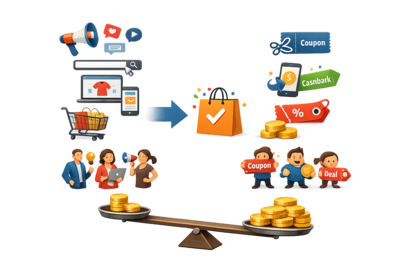
Last-click attribution has been the default measurement model in affiliate marketing for more than a decade. It is simple, cheap, and technically easy to implement: whoever delivers the final click before a purchase receives all of the credit. For an early program with a handful of partners and short, linear buying journeys, that is a reasonable approximation of who drove the sale. At scale, the approximation collapses. Customer journeys fragment across devices, sessions, and channels, and the final click stops being a proxy for who actually created demand. Instead of measuring contribution, last-click rewardstraffic interception— the partners who sit closest to the checkout button — while quietly defunding the partners who created the demand in the first place. This is why growing programs increasingly move towardmulti-touch attributionand incrementality testing. Below is why last-click fails, what it costs, and what to use instead.
Last-Click vs Multi-Touch Attribution: Model Comparison
Before diagnosing the failures, it helps to see how the majoraffiliate attribution modelsassign credit. Last-click is only one point on a spectrum that runs from single-touch shortcuts to contribution-based measurement, and each model tells a different story about the same journey. The table below compares the models most affiliate programs evaluate at scale.
Affiliate Attribution Models
Exact model behavior depends on your tracking stack, lookback windows, and cross-device capabilities — confirm what your platform actually supports and verify current terms with your provider rather than assuming.No single model is correct everywhere. The practical takeaway is that last-click is the least informative option for a scaled program, because it discards every interaction except the last one. Everything that follows is a symptom of that single design choice.
How Much Is Last-Click Attribution Costing You?
Last-click does not change how many sales happen — it changes who gets paid for them. That distinction is where the money leaks. The direct cost has two parts. The first iscommission leakage: paying full commission on conversions that would have happened anyway, usually to coupon, cashback, and deal partners that intercept existing intent at the checkout stage. The second ismisallocation: cutting or underfunding the content, comparison, and influencer partners that actually generate demand, which slowly shrinks the top of the funnel and starves future growth. To size the leakage, look at what those bottom-of-funnel conversions are paid. In performance programs, a credited partner might earn a first-time-deposit CPA in the low hundreds of euros, or a revenue share of roughly a quarter to nearly half of net revenue for the lifetime of the customer. When a meaningful share of those credited conversions are non-incremental — buyers who were already going to convert — that commission is pure margin loss, repeated on every order. The useful reframe is to stop asking “which partner got the last click?” and start asking “which partners changed the outcome?” The second question is the only one that maps spend to growth, and it is exactly what incrementality testing answers. It is also the fastest way to put a real number on your leakage instead of guessing.
How Payout Models Amplify Attribution Errors
Attribution and payout structure are usually treated as separate decisions. They are not. Your commission model determines how expensive an attribution error becomes, because it decides how much you actually pay the partner that last-click happens to credit. The three dominantaffiliate payout models— CPA, revenue share, and hybrid — each interact with last-click differently. The table shows typical iGaming ranges, since that is where the stakes are highest, alongside the attribution risk each one carries.
Affiliate Payout Models and Attribution Risk
Figures are 2026 industry ranges and vary widely by GEO, vertical, traffic quality, and negotiation — verify current terms before modeling payouts.The pattern is consistent across every model: last-click sends the payout to the final-click partner and nothing to the partners that created the demand. Under CPA, that means a full first-time-deposit fee to a coupon site; underrevenue share, a lifetime cut of net revenue to a partner that may have added no incremental value at all. Choosing the right structure is a real lever here — iRev’s guide on how tochoose the right commission modelwalks through the trade-offs — but no payout model fixes an attribution model that only ever looks at the last step.
Over-Crediting Bottom-of-Funnel Partners
As programs grow, bottom-of-funnel partners — coupon sites, cashback platforms, loyalty apps, and deal aggregators — come to dominate last-click reports. They appear right before conversion not because they created demand, but because users deliberately seek them out at the final step: opening a new tab to search “[brand] promo code” after they have already decided to buy. The result is thatcoupon site attributionandcashback attributionsystematically overstate these partners’ contribution. High visibility in the report is mistaken for high incremental value, and the program ends up paying most for the partners that intercept intent rather than the ones that create it. Common consequences include:
- Inflated conversion rates for coupon and cashback affiliates, since they only ever touch users who are already converting
- Commission leakage on transactions that would have completed organically
- Falling investment in the partners that introduce genuinely new users
This bias compounds as scale grows: deal-seeking traffic expands faster than discovery-driven traffic, so the more you scale under last-click, the more your reported “winners” are simply the best-positioned interceptors. The economic picture inverts — you reward traffic interception and underfund customer acquisition.
The Erased Middle: Content, Influencers, and Assisted Value
Upper- and mid-funnel affiliates — content publishers, bloggers, comparison and review sites, communities, and influencers — rarely earn the last click. Their role is to inform and persuade earlier in the decision cycle, so they usually hand the user off long before checkout. Under last-click, these partners are effectively deleted from the report. The data then tells a false story: that content and influence “underperform,” even though they drove the awareness, consideration, andassisted conversionsthat made the final click possible in the first place. Key effects include:
- Loss of visibility into assisted-conversion paths and the partners that start them
- Underestimation of content- and creator-driven demand generation
- Systematic underpayment of high-effort partners, who eventually leave
At scale this becomes self-reinforcing. As content and creator partners are defunded, the top of the funnel shrinks, demand growth slows, and the program leans even harder on the transactional traffic that last-click already over-rewards. For a breakdown of how these partners actually behave and where each fits, see iRev’s guide toaffiliate partner types.
How Last-Click Distorts Partner Incentives
Attribution models do not just measure behavior — they shape it. When last-click is the only thing that pays, rational partners stop trying to create value earlier in the funnel and start competing to be the final touch. That pushes partners toward tactics such as:
- Bidding on the advertiser’s own brand keywords to intercept users who were already searching for the brand
- Cookie overwriting and forced redirects to claim the last click
- Aggressive coupon injection and toolbar pop-ups at checkout
These are logical responses to the incentive structure, but they are corrosive.Affiliate program scalingunder last-click tends toward a race to the bottom: high-effort partners exit because they cannot win the last click, and low-effort arbitrage players move in because they can. Over time the partner mix degrades and the program becomes dependent on non-incremental traffic — the opposite of durable growth, and one of the quieter reasonsprograms stall after early momentum.
Cross-Device, Channel Overlap, and Multi-Market Blind Spots
Two structural problems get worse the larger a program becomes: channel overlap and cross-device journeys.Channel overlap.Mature programs run alongside paid search, retargeting, email, and paid social. Last-click cannot resolve these interactions coherently, so it tends to:
- Assign affiliate credit to conversions that paid media actually drove
- Double-count value across internal and partner channels
- Allocate credit by click timing rather than genuine influence
Without a multi-touch view, attribution stops being a measurement system and becomes a reflection of technical tracking order — whichever pixel fired last wins.Cross-device and multi-market.Users research on mobile and buy on desktop; they take days or weeks to decide.Cross-device affiliate trackinggaps mean the discovering partner is often invisible by the time the sale lands. Scale this internationally and it compounds: research duration, device switching, and channel trust vary by region, so last-click penalizes markets with longer consideration cycles and overvalues markets with heavy deal usage. The outcome is misread regional performance and budget sent to the wrong GEOs. This is also why attribution and downstream routing are increasingly discussed together — seeattribution vs lead distribution.
Attribution in iGaming, Finance, and Regulated Verticals
Nowhere does last-click fail more expensively than in high-value, regulated verticals like iGaming, sports betting, and finance — which is exactly where iRev’siGaming & casino softwareandlead distributionsolutions are used every day. Two things make these verticals different. First,value is realized over time.A depositing player or a funded trading account is worth far more across its lifetime than at the first conversion, so paying a full CPA or a lifetime RevShare to whichever partner caught the last click is a large, recurring bet on a single data point. Second,the funnel is long and content-heavy.Review sites, comparison portals, streamers, and communities do the persuading; a bonus or coupon page frequently steals the last click. Under last-click, the review site that built the trust earns nothing and the coupon page earns the deposit. For finance and lead-generation programs, the same logic runs from first click tofunded-account attribution: a lead is not revenue, and the partner credited at form submission is often not the partner that produced a funded, qualified customer. Player- and customer-level attribution, not last-click, is what keeps payouts aligned with real value. For deeper reading, see iRev’s guides toscaling iGaming affiliate programsandCPA vs RevShare in online gambling.
How to Move Beyond Last-Click Attribution (Step by Step)
Replacing last-click does not require rebuilding your stack overnight. A staged approach works better, because it keeps payouts stable while you learn where the credit really belongs.
- Baseline with assisted-conversion reporting. Before changing any payouts, turn on assisted-conversion and path reports so you can see which partners appear earlier in journeys. This alone exposes the erased middle.
- Add a multi-touch model for analysis. Layer a position-based or time-decay model beside last-click, for reporting only at first. Comparing the two views shows you exactly which partners are over- or under-credited.
- Run incrementality tests. Use holdouts and geo tests to measure which partners actually change outcomes. This is the ground truth that model choice can only approximate — see iRev’s guide to measuring incrementality.
- Fix tracking first. Multi-touch is only as good as the data feeding it. Move to first-party and server-side tracking so cross-device and post-cookie journeys are actually captured.
- Re-align payouts gradually. Introduce blended or hybrid commissions that reward both introduction and closure, and adjust based on measured incrementality rather than last-click position.
The goal is not a “perfect” model — none exists — but a system where what you pay for matches what actually drives growth.
Attribution Compliance and Data Risks in 2026
Attribution in 2026 is also a data-governance problem. Third-party cookies are unreliable across major browsers, privacy regulation is stricter, and regulated verticals face active enforcement. Last-click makes all of this harder, because it leans so heavily on the single, fragile final-click signal.
Attribution Compliance and Data Risks
Regulatory obligations vary by jurisdiction and change frequently — treat this as a general overview, not legal advice, and verify current requirements for your markets.The through-line is that durable attribution now depends on your own first-party data and server-side infrastructure, not on browser cookies or ad-platform promises. Fraud reviews in regulated verticals routinely flag a significant share of affiliate-driven sign-ups as suspicious, and last-click’s thin signal does little to catch it. For the practical playbook, see iRev’s guides tocookieless affiliate trackingandaffiliate compliance in regulated verticals.
Run a program that pays for real contribution. iRev’s partner platform brings multi-touch reporting, player- and customer-level attribution, first-party and S2S tracking, and flexible CPA / RevShare / hybrid payouts into one system — so you can move past last-click without losing control of payouts. Book a demo to see it on your own data.
Conclusion
Last-click attribution fails at scale because it was never designed for complex, multi-touch journeys. It rewards the partners closest to the checkout button, erases the partners that create demand, and turns your commission budget into a subsidy for traffic interception. Every structural problem it causes — over-credited coupon sites, defunded content, gamed incentives, misread markets — gets worse, not better, as the program grows. The fix is not a single “best” model but a shift in the question you ask: from “who got the last click?” to “who actually changed the outcome?” Programs that answer the second question — with multi-touch reporting, incrementality testing, and first-party tracking — pay for growth they can trust. Moving beyond last-click is not an analytics upgrade; it is a requirement for scalable, profitable affiliate growth.
Frequently Asked Questions (FAQ)
[1] What is last-click attribution in affiliate marketing?
Last-click attribution assigns 100% of a conversion’s credit to the final touchpoint before purchase. Whichever partner delivered the last click gets paid in full, and every earlier interaction in the journey is ignored.
[2] Why does last-click attribution fail at scale?
As programs grow, customer journeys fragment across devices, channels, and touchpoints. The final click stops representing who created the sale, so last-click over-credits bottom-of-funnel partners, erases upper- and mid-funnel influence, and misallocates budget.
[3] Is coupon and cashback traffic actually incremental?
Often only partially. Coupon, cashback, and deal partners typically appear at the final step for users who had already decided to buy, so a meaningful share of the conversions they are credited for would have happened anyway. Incrementality testing is the way to measure the real share.
[4] What is the difference between last-click and multi-touch attribution?
Last-click gives all credit to one interaction. Multi-touch attribution distributes credit across several touchpoints in the journey, so partners that introduce and nurture customers are recognized alongside the one that closes the sale.
[5] Which attribution model is best for affiliate programs?
There is no universal winner. Most scaled programs combine a multi-touch model for reporting with incrementality testing for ground truth, rather than relying on any single model or on last-click alone.
[6] How much can last-click attribution overpay partners?
It varies by program, but the cost is the commission paid on non-incremental conversions plus the growth lost by underfunding demand-creating partners. Because payouts can reach hundreds of euros per CPA or a lifetime revenue share, even a modest non-incremental share can be expensive. Incrementality tests size it for your program.
[7] Does last-click attribution work for iGaming or finance programs?
It is especially risky there. Value is realized over a customer’s lifetime and the funnel is long and content-heavy, so paying full CPA or lifetime RevShare on a single last click frequently rewards the wrong partner. Player- and funded-account-level attribution fits these verticals far better.
[8] How do you move from last-click to multi-touch attribution?
Start with assisted-conversion reporting, add a multi-touch model for analysis, run incrementality tests, upgrade to first-party and server-side tracking, then re-align payouts gradually based on measured contribution.
[9] Can affiliate networks and software support non-last-click attribution?
Some networks offer only partial support, which is why many programs use dedicated platforms or external analytics. Purpose-built partner platforms can combine multi-touch reporting, incrementality inputs, and flexible payouts in one place.
[10] What is incrementality testing and why does it matter?
Incrementality testing uses holdouts and geo experiments to measure which partners actually change outcomes rather than which happened to be last. It is the most reliable way to find non-incremental spend and to value demand-creating partners correctly.
Become a champion with irev
[Only 9 slots left this month]


Irev puts your partner program on the fast track to real growth


 SIGMA Award Winner
Best marketing solution provider
SIGMA Award Winner
Best marketing solution provider