
Post-Conference Partner Onboarding Stack: First 30 Days From Booth Lead to First Conversion

Introduction
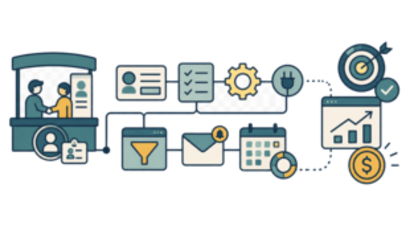
The transition from a handshake at a conference booth to a functioning revenue-generating partnership is where most marketing ROI dies. Industry data indicates that a significant percentage of event leads never receive a single follow-up, resulting in wasted travel budgets and missed growth opportunities. A professional affiliate partner onboarding process requires a rigid, automated framework to ensure no contact falls through the cracks during the critical month following an event.
Shifting to a standardized onboarding stack transforms this chaotic phase into a predictable engine for growth. By implementing a system that manages data entry, technical integration, and educational workflows, businesses can accelerate their partner activation strategy. This guide outlines a 30-day operational blueprint designed to minimize friction and maximize the efficiency of your event-sourced partnerships.
Day 1: Data Sanitization & CRM Hygiene
The first 24 hours determine the feasibility of your post-conference lead follow-up. Delaying data input into the CRM leads to information decay, where specific context from conversations—such as technical requirements or preferred payment models—is forgotten. Immediate digitization is not optional; it is the foundation of the entire 30-day lifecycle.
To maintain order, organizations must centralize event data within a robust affiliate tracking platform that serves as the single source of truth for all partnership data. Establish a rigid protocol for data entry that includes:
- De-duplication: Running an automated check against existing records to prevent contact fragmentation.
- Categorization: Tagging leads based on the specific event, the booth representative who made the contact, and the primary topics discussed.
- Ownership Assignment: Automatically routing leads to the account managers identified during the event, ensuring immediate accountability.
Day 2-5: Automated Personalization Stack
Generic follow-up emails result in low engagement rates. Prospects meet dozens of vendors at conferences, and a non-personalized message quickly becomes indistinguishable noise. A robust CRM workflow for partnerships uses the metadata captured on Day 1 to trigger personalized, context-aware email sequences that reference specific points of interest.
Instead of a generic “Nice to meet you,” the automated stack should deploy content based on the lead’s profile:
- If “Crypto/Fintech” was tagged: Trigger a sequence highlighting your compliance stack and payment speed.
- If “Media Buying” was tagged: Trigger a sequence showcasing current offers, tracking capabilities, and top-performing creatives.
- If “Consultation” was requested: Automatically sync with the account manager’s calendar to propose a direct meeting time.
Week 1: The “Partner Starter Kit” (Educational)
Empowering new partners requires providing immediate value through structured educational resources. A partner who understands your value proposition and technical requirements within the first week is significantly more likely to drive traffic than one left to navigate the dashboard alone. This phase relies on B2B onboarding automation to deliver a “Starter Kit” via email or secure portal.
The starter kit must contain:
- Media Assets: A curated pack of high-converting banners, landing page templates, and promotional copy.
- Technical Documentation: Direct links to API guides, postback setup instructions, and pixel implementation tutorials.
- Compliance Guidelines: A clear document outlining permissible traffic sources and prohibited promotional methods to prevent immediate policy violations.
Week 2: Compliance & Legal Automation
The legal and regulatory phase often acts as a bottleneck that stalls potential partnerships for weeks. Streamlining this process requires an automated workflow that manages KYB/KYC documentation and contract signing before technical integration begins. By removing manual document handling, you significantly improve your speed to first conversion.
| Feature | Manual Process | Automated Process |
|---|---|---|
| Contract Signing | Emailing PDFs back and forth | DocuSign / HelloSign integration |
| Identity Verification | Manual review of documents | Automated API-based KYB checks |
| Terms Acceptance | Verbal / Email agreement | Digital “Click-to-Accept” in portal |
Week 3: Technical Integration Setup
Technical friction is the primary cause of partner attrition. If a partner cannot successfully test a postback or pixel within 21 days, they will likely divert their resources to a competitor. For iGaming and betting brands, this is critical; using specialized iGaming affiliate software allows you to provide partners with pre-configured, integration-ready tools, minimizing the time needed for technical setup.
Verification protocols during this phase include:
- Pixel/Postback Testing: Ensuring the partner’s environment communicates correctly with your platform.
- Tracking Validation: Running a small “test” click and conversion scenario to confirm the attribution chain works.
- Dashboard Walkthrough: A scheduled 15-minute screen share to help the partner understand how to pull their own reports and monitor their performance.
Week 4: The First Campaign Launch
Transitioning to “Live” traffic is the final operational hurdle. This week focuses on the affiliate lead conversion framework, ensuring that the partner’s initial creative and landing page alignment meets your internal quality standards. Providing proactive feedback on the first campaign increases the likelihood of long-term retention.
Key actions for Week 4:
- Creative Review: Providing minor adjustments to landing page copy or creative design to optimize for higher conversion rates.
- Traffic Quality Monitoring: Keeping a close eye on early metrics to identify potential fraud or low-quality traffic patterns before they scale.
- First Payout Discussion: Clearly setting expectations regarding payment schedules and thresholds to build confidence in your reliability.
Day 30: Performance Review & Feedback Loop
At the 30-day mark, conduct a formal evaluation to determine the partner’s status. Data now provides a clear picture of whether the partner is a long-term “scaler” or a low-value contact. For high-volume programs, teams should leverage an automated lead distribution solution to analyze which traffic sources are delivering the highest ROI, allowing you to decide whether to increase support or deprioritize the account to focus resources on higher-performing partners.
Key questions for the day 30 review:
- Did the partner successfully drive and convert traffic?
- Were there technical or communication bottlenecks that hindered performance?
- Does the partner demonstrate the capacity to scale their volume in the coming quarter?
Conclusion
A documented onboarding stack transforms event ROI from a subjective estimate into a repeatable business process. By standardizing the journey from booth lead to first conversion, organizations minimize the risk of partner churn and maximize the lifetime value of every relationship. Documentation, automation, and speed remain the defining characteristics of a high-performing partnership program.
FAQ
[1] What is the best approach if a partner does not respond to Week 1 or Week 2 emails?
Implement a “break-up” workflow. After three unanswered emails, send a final check-in stating that you are closing their onboarding file due to lack of activity, but they are welcome to reconnect if their priorities change. This often triggers a response if they have been busy.
[2] Should I prioritize technical integration over content or strategy?
Always prioritize technical integration. A partner with excellent marketing strategy but a broken tracking pixel results in zero revenue. Ensure technical tracking is flawless before focusing on content optimization.
[3] How do I handle persistent integration errors during Week 3?
If a partner struggles repeatedly, do not allow it to linger. Immediately escalate the account to a technical support specialist for a dedicated screen-share session. Providing hands-on support at this stage demonstrates your commitment to their success and prevents account abandonment.
[4] What is affiliate onboarding automation?
Affiliate onboarding automation replaces manual steps like emailing PDF contracts, reviewing documents by hand, and tracking terms acceptance in spreadsheets with integrated digital workflows. Tools like DocuSign or HelloSign handle contracts, API-based KYB providers verify identity, and partner portals capture click-to-accept agreements automatically.
The goal is not just speed but auditability. Every step is logged, timestamped, and reportable, which reduces compliance risk and makes payout disputes easier to resolve.
[5] How long does manual affiliate onboarding actually take?
Manual onboarding typically takes 5 to 14 days from application to first link generation. Most of that time is waiting — for signatures, document review, internal approvals, and back-and-forth email clarifications. Active processing time is usually under 2 hours, but spread across multiple people and days.
Automated onboarding reduces this to 30 minutes to 24 hours depending on KYB complexity. The compounding effect matters: a 10-day delay across 100 new partners equals 1,000 lost activation-days per year.
[6] Is KYB (Know Your Business) verification mandatory for affiliate programs?
KYB is not legally mandatory for most affiliate programs, but it is strongly recommended in regulated verticals — finance, iGaming, healthcare, and crypto. Even in unregulated verticals, KYB protects against fraud, fake publishers, and reputational risk from low-quality traffic sources.
Most modern affiliate platforms integrate with KYB providers like Sumsub, Onfido, or Veriff via API, so the verification happens during signup without manual intervention.
[7] What is the difference between KYC and KYB for affiliates?
KYC (Know Your Customer) verifies individual identities — passport, selfie, address. KYB (Know Your Business) verifies company entities — registration documents, beneficial ownership, tax IDs, sanctions screening. For affiliate programs, KYB applies when the partner registers as a legal entity, while KYC applies to solo affiliates and individual content creators.
Most programs need both: KYC for sole proprietors and influencers, KYB for media agencies and publisher networks. A good onboarding platform handles them in the same workflow based on partner type.
[8] Which tools should I use to automate affiliate onboarding?
A typical automated onboarding stack includes a partner platform for application and portal access, an e-signature tool like DocuSign or HelloSign for contracts, a KYB provider for verification, and a CRM or workflow engine to route approvals. Some platforms bundle all of these into one product.
The choice depends on volume. Programs onboarding under 50 partners per month can use simpler tools. High-volume programs (500+ partners monthly) need API-first platforms with custom approval logic and bulk processing capabilities.
Become a champion with irev
[Only 9 slots left this month]
Irev puts your partner program on the fast track to real growth


 SIGMA Award Winner
Best marketing solution provider
SIGMA Award Winner
Best marketing solution provider